
The way people work in Barrie has changed.
Private office vs Coworking space, for many professionals, the choice is no longer between working from home and signing a multi-year commercial lease. Private offices, coworking spaces and other flexible workspace options have created a middle ground.
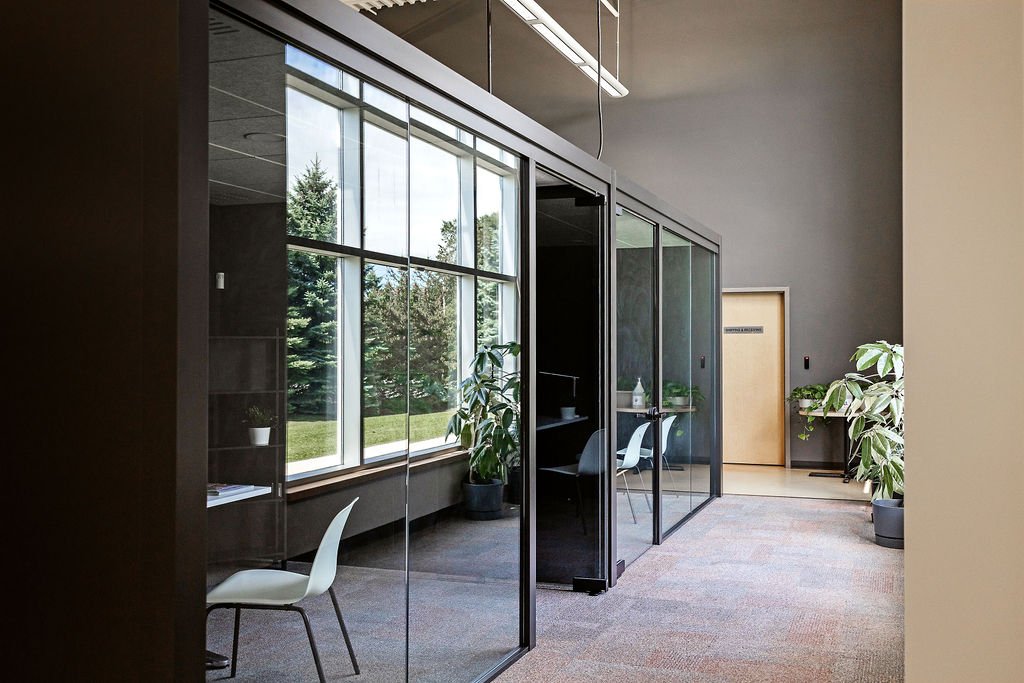
That flexibility is useful, but it creates another decision: should you choose a private office or coworking space?
The answer depends on what your workday actually looks like.
Someone who spends hours on confidential calls has different needs from a freelancer who wants to get out of the house a few days a week. A corporation looking for workspace for three Barrie-based employees has different requirements from a startup trying to keep its monthly expenses flexible.
Before choosing a workspace, it helps to understand where private offices and coworking differ and where they overlap.
What Is a Private Office?
A private office is an enclosed workspace within a larger office or business centre.
Unlike a traditional commercial office, you don’t necessarily have to lease an entire unit, furnish it and arrange all of the services needed to operate it. Depending on the workspace provider, furniture, internet, utilities, cleaning and shared amenities may already be available.
The main advantage is straightforward: you can close the door.
That matters more for some businesses than others.
If your day includes client calls, virtual meetings, financial discussions, sensitive information or long periods of focused work, an enclosed office can make your workday easier.
Private offices can also give businesses a consistent professional location without requiring them to operate an entire office facility.
For businesses researching this option locally, our guide to private office space in Barrie explains the different ways private offices can be used.
What Is Coworking Space?
Coworking takes a different approach.
Instead of having your own enclosed office, you work within a shared professional environment. Other people around you may be freelancers, business owners, remote employees, consultants or people working for larger companies.
You aren’t working together. You’re simply working in the same professional environment.
For many people, that’s exactly what they want.
Working from home can be convenient, but after months or years of doing it, the downsides can become noticeable. Household distractions creep into the day. Work starts spreading into evenings. The kitchen table becomes an office. There is no clear point when the workday starts or ends.
Coworking creates separation without requiring a permanent private office.
You leave home, go somewhere specifically to work and leave again when the workday is finished.
For someone who mainly needs a desk, Wi-Fi and a professional environment, that can be enough.
Private Office vs. Coworking Space: What’s the Main Difference?
Privacy is the obvious difference, but it isn’t the only one.
A private office gives you greater control over your immediate environment. Coworking gives you greater access to a shared environment.
Which one is better depends on how you work.
Privacy
If you spend much of the day on calls or discussing information that shouldn’t be overheard, a private office has a clear advantage.
You can close the door and have the conversation.
Coworking works better when most of your work can comfortably be done around other people. Private phone booths and meeting rooms can help when you occasionally need privacy, but your primary workspace remains shared.
Focus
Some people concentrate better with activity around them. Others don’t.
If conversations, movement and background noise easily pull you away from your work, an enclosed office may be worth the additional cost.
If you enjoy having other professionals around and don’t need complete silence, coworking can provide a welcome alternative to working alone.
Cost
Coworking will generally be the more economical choice because the primary workspace is shared.
With a private office, you’re paying for the additional privacy and dedicated space.
But comparing price alone can be misleading.
The better question is whether you’re paying for something you actually use.
Someone who needs privacy throughout most of the day may get considerably more value from a private office. Someone who spends half the week visiting customers may be paying for a private room that sits empty.
Client Meetings
Think about how often clients actually come to see you.
If client appointments are a regular part of the week, having access to a private professional environment may be important.
If you only meet clients occasionally, coworking combined with access to a meeting room can be a more practical arrangement.
You don’t necessarily need to maintain a private office every day just to have somewhere professional for a meeting twice a month.
When Does a Private Office Make More Sense?
There isn’t a specific point where a business suddenly becomes “big enough” for a private office.
It has much more to do with the type of work being done.
Your Day Is Filled With Calls
If you’re constantly stepping away from a shared workspace to take calls, the arrangement probably isn’t working particularly well.
An enclosed office lets you make calls and join virtual meetings without repeatedly moving somewhere else.
You Handle Confidential Information
Accountants, financial professionals, consultants, recruiters and other professionals may regularly discuss information that isn’t appropriate for an open workspace.
Privacy isn’t simply a preference in these situations. It’s part of how the work needs to be done.
Clients Regularly Visit You
Meeting someone at a coffee shop occasionally is one thing.
Doing it three times a week is another.
A professional workspace creates consistency. Clients know where they’re going, you know what the environment will be like and you’re not depending on whether a quiet table happens to be available.
You Need to Concentrate for Long Periods
Some work requires uninterrupted attention.
If you regularly spend several hours writing, designing, analyzing information, preparing reports or working through complex projects, having a door between you and the activity outside can be valuable.
You Want a Regular Business Base
You may not need your own commercial unit, but you may still want somewhere that feels like your office.
A private office can provide that middle ground.
When Is Coworking the Better Choice?
Coworking makes sense when the benefits of flexibility outweigh the need for a dedicated room.
You’re Working From Home and Need a Change
This is one of the simplest reasons to use coworking.
You don’t necessarily need an office. You just need somewhere other than home where you can get a solid day of work done.
A dedicated work environment can also help rebuild the boundary between work and personal time.
You’re Rarely at a Desk All Week
Salespeople, consultants, contractors and other professionals may spend significant portions of their week away from their desks.
If you’re regularly visiting customers or travelling, a permanent private office may not provide enough value.
Coworking gives you somewhere professional to work on the days you’re actually at a desk.
You’re Keeping Business Overhead Flexible
New and growing businesses don’t always know what their space requirements will look like six or twelve months from now.
Starting with coworking can give the business room to figure that out before taking on more space.
You Don’t Want to Work Alone
This gets overlooked.
Some people simply prefer having other people around.
You don’t need to collaborate with everyone in the room to appreciate the energy of working in a professional environment instead of sitting alone at home all day.
What About Corporations and Established Companies?
Flexible workspace is sometimes associated with freelancers and startups, but established companies have plenty of reasons to use it.
Imagine a Toronto company with four employees who live in Barrie.
Does it make sense for those employees to commute to Toronto every day?
Does the company need to open another conventional office for four people?
Maybe not.
A private office could provide those employees with a consistent local workspace. Coworking could make sense if they only need office space two or three days per week.
The same applies to regional managers, travelling employees, temporary project teams and companies testing a new market.
Flexible office space gives established businesses another option between having no local workplace and opening an entire branch office.
Hybrid Work Has Changed the Office Decision
Before hybrid work became common, companies generally planned office space around the assumption that most employees would be there most days.
That assumption doesn’t always hold anymore.
If employees work remotely two or three days per week, maintaining a dedicated desk for every employee can leave large portions of an office unused.
This is where flexible workspace becomes particularly useful.
An employee might use coworking for regular workdays, a private office when they have a schedule full of calls and a boardroom when the entire team needs to meet.
Instead of asking, “How much office space do we need?”
A better question may be:
What types of workspace does our team need, and how often do they need each one?
That’s a very different way of planning an office.
You Don’t Necessarily Have to Choose One
This is probably the biggest misconception about private offices and coworking.
They’re often presented as competing options.
In practice, many professionals need both.
You might use coworking three days a week but reserve a private office when you have several virtual meetings scheduled.
You could have a private office for everyday work but book a larger boardroom when eight people need to meet.
A company might maintain private offices for regional managers while giving hybrid employees access to shared workspace.
The goal isn’t to choose a category.
It’s to have access to the right space for the work you’re doing.
What About a Day Office?
A day office sits somewhere between coworking and a full-time private office.
You get a private workspace, but only for the day.
That can work particularly well when your normal routine doesn’t justify a dedicated office.
Maybe you have six virtual meetings scheduled on Tuesday. Perhaps a client is coming into Barrie. You might need uninterrupted time to finish a proposal.
Instead of committing to a private office every month, you can use one when the work calls for it.
For people who generally work remotely or use coworking, a day office rental in Barrie can fill that occasional need for privacy.
Don’t Forget About Meeting Space
Your everyday workspace doesn’t need to accommodate the largest meeting you might hold all year.
That’s one of the hidden costs of traditional office planning.
A company might lease considerably more space because it wants a conference room that sits empty most of the week.
Flexible meeting space changes that calculation.
If you’re meeting one or two people, a smaller meeting room may be enough.
If you’re bringing together executives, employees or clients, you can reserve a larger boardroom in Barrie for that particular meeting.
When training a larger group, a dedicated training room may make more sense.
You use the space when you need it rather than maintaining it every day.
Think About Location Before Choosing a Workspace
The workspace itself matters, but so does everything around it.
How easy is it to get there?
Can clients park?
Can employees get lunch nearby?
Can you run errands during the day?
Is there somewhere nearby to work out before work, over lunch or on the way home?
These details seem minor when you’re comparing websites. They become much more important when you’re actually using the space several times per week.
SuiteWorks is located at 92 Caplan Avenue in South Barrie, with free on-site parking available on a first come, first served basis.
The surrounding area provides access to restaurants, shops, everyday services and nearby gyms and fitness facilities, which can make a regular workday considerably more convenient.
Private Office vs. Coworking Space at a Glance
| Consideration | Private Office | Coworking |
| Privacy | High | Shared environment |
| Dedicated space | Available | Shared |
| Frequent calls | Strong fit | Better for occasional calls |
| Focused work | Strong fit | Depends on preference |
| Client meetings | Professional private setting | Meeting rooms can be reserved |
| Flexibility | Hourly through full-time | Strong |
| Cost | Generally higher | Generally lower |
| Working around others | Less | More |
| Remote employees | Strong fit | Strong fit |
| Startups | Good when privacy is important | Good for flexible overhead |
| Corporations | Good for regional and satellite staff | Good for hybrid employees |
| Occasional use | Day and hourly offices | Strong fit |
Questions to Ask Before You Decide
Don’t start by asking which option is better.
Look at a normal workweek and ask:
- How many days per week do I actually need workspace?
- How many hours do I spend on calls or virtual meetings?
- Do clients regularly visit me?
- Does my work involve confidential conversations?
- Do I concentrate better alone or around other people?
- Do I need a permanent desk?
- How often does my team need to meet in person?
- Am I paying for office space that regularly sits empty?
- Could my workspace requirements change over the next year?
- Would having access to several types of workspace be more useful than maintaining one permanent space?
Your answers will usually make the decision much clearer.
Finding Flexible Workspace in Barrie
There isn’t one workspace that’s right for every business.
A private office makes sense when privacy, consistency and concentration are important.
Coworking makes sense when flexibility, affordability and a shared professional environment matter more.
A day office works when you only need privacy occasionally.
Meeting rooms and boardrooms solve the problem of needing more space without having to maintain it permanently.
SuiteWorks brings those options together at one business centre in South Barrie.
That means your workspace doesn’t have to stay the same as your business changes.
You can start with coworking, use a private office when you need more privacy, reserve meeting rooms when clients visit and explore more permanent office options as your business grows.
Sometimes the best choice isn’t private office or coworking.
It’s having access to both.
Explore Your Workspace Options at SuiteWorks
If you’re deciding between coworking and a private office, seeing the spaces in person can make the choice much easier.